Gold Buying Guide
Three things about the piece, four about the quote, and all seven on the bill before you pay. The piece: the hallmark and its HUID, the purity it is marked at, and how much of its weight is gold once the stones come off. The quote: the rate per gram and when that rate was published, the making charge and the basis it is quoted on, anything charged on top of it, and the tax.
What to check before buying gold jewellery
Each of these is a question you can ask out loud at the counter, in the order it comes up.
- Know the day's gold rate and the time it applies from.The latest 22K figure is ₹14,010 per gram, as on 25 September, 9:36 am. Check it before you leave, and read the shop's own board rate against it.
- Ask whether the weight quoted is gross or net gold.Stones and non-gold parts come off once, before the gold is priced. Only the gold is worth the gold rate.
- Look at the hallmark yourself.Three marks: the BIS logo, the purity such as 22K916, and a six-character HUID. Shops keep a 10x magnifier for customers to read them with.
- Check the HUID before paying, not after.The Verify HUID feature in the BIS Care app returns the article's details and the jeweller's registration. It is free: check the hallmark and HUID at the counter.
- Ask for the estimate in writing, itemised.Net weight, purity, the rate per gram and each charge on its own line. Two quotes cannot be compared until both are written down the same way. Negotiating making charges starts from that written estimate.
- Get the making charge and its basis.A percentage of the gold value and a rupees-per-gram quote give different bills on the same piece. Convert one into the other before comparing gold making charges.
- Ask whether wastage is included or extra.A quote with wastage inside the making charge and one with wastage on top are not the same offer. Add the wastage or VA percentage to the making charge before comparing.
- Get the exchange and buyback terms before you buy.Each shop sets its own deduction on old gold, and the time to learn it is while you still have a choice. Ask for the terms in writing, and work out the exchange value yourself.
- Check the bill shows purity, net weight, the hallmarking charge and the tax.For a hallmarked article the first three are required, and the bill is what any later claim rests on.
The rate to compare a quote against
The latest 22K gold rate in Nagercoil is ₹14,010 per gram, ₹1,12,080 per pavan (8 grams), as on . That is the figure to hold a quote against, and 18K has a rate of its own rather than a share of this one.
The rate above is for the metal alone: a shop's board rate may differ, and making charges, any separately quoted wastage and GST come on top of it.
Two shops can quote the same piece and mean different things by it, so fix four points before comparing anything: the purity, the rate per gram and when it was published, the weight basis, gross or net gold, and what the quoted figure already includes. A number without those four is not a price you can check.
On some days the rate moves again later in the day, so a quote taken at noon and one taken at five can be worked on different figures, which the history explorer shows day by day. Ask which rate per gram the estimate was worked on, and whether that is the rate the bill will use.
Choose the purity for what you are buying
Carat measures gold in twenty-fourths; fineness measures it in thousandths. 22 carat is 22 parts in 24, which is 91.6%, written 916 on the mark. 18 carat is 75.0%, written 750. The two are separate hallmarking grades with separate rates, and neither is ever worked out as a share of the other.
Which one to buy follows from the purchase rather than from the number. A piece meant to be worn needs the strength that alloying gives it; metal meant to be kept as metal does not. 22K and 24K gold suit different purchases.
Mandatory hallmarking covers six caratages: 14K, 18K, 20K, 22K, 23K and 24KS. IS 1417:2016 also provides for 9K as a voluntary grade, so 14K is the lowest caratage a shop can have hallmarked under the order.
Whatever a piece is called at the counter, the purity that counts is the one struck on it. The local phrase "916 KDM" runs a purity together with an old soldering term, and an assaying centre will not hallmark an article that already carries a KDM or caratage mark of its own. 916 and KDM are not one grade.
The rate on this site is for 22K, with 18K alongside it; the 24K figure is a national benchmark for 999 fine gold, which is a bar and coin price rather than a jewellery rate.
What the hallmark tells you, and what it does not
A current BIS hallmark carries three marks: the BIS logo, the purity in carat and fineness, and a six-character HUID, unique to that one article and traceable, introduced on 1 July 2021. It certifies the fineness of the metal after testing at an assaying and hallmarking centre, and it holds good for the lifetime of the piece. It says nothing about the price, the making charge, the stones or the shop's terms. A hallmarked piece can still be an expensive one, and two shops can sell the same hallmarked grade at different totals.
Check the HUID yourself before paying. BIS publishes its own free app, BIS Care, whose Verify HUID feature returns the article's details and the registration of the jeweller who had it hallmarked. If the purity it reports is not the purity you are being billed at, stop there.
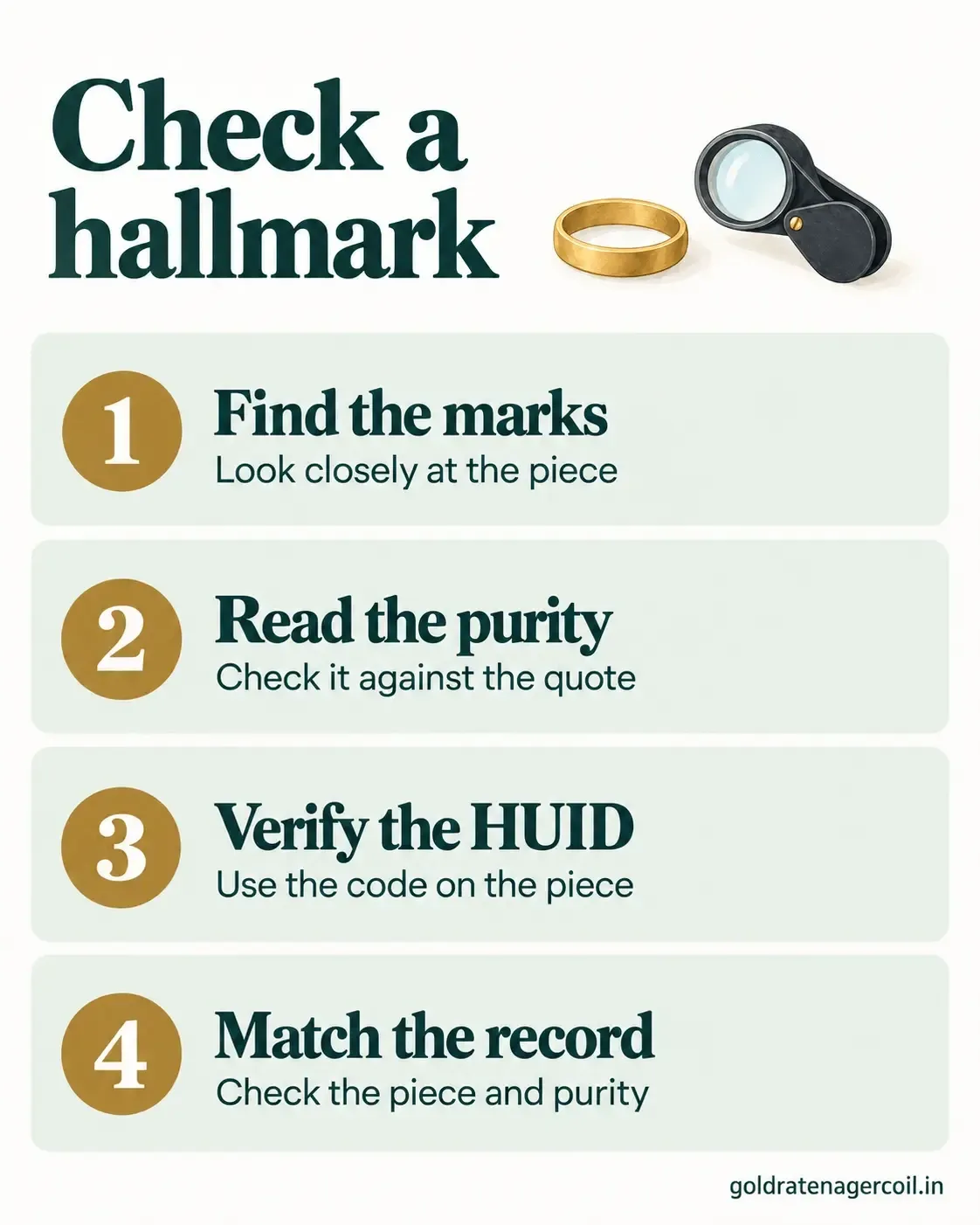
If a hallmarked piece later tests below its marked purity, the buyer is entitled to compensation of twice the difference in value plus the testing charges, owed by the registered jeweller who made the sale. That claim rests on the mark and the bill together, which is the practical reason to check both at the counter rather than after paying.
Any BIS recognised assaying and hallmarking centre will test a consumer's own piece on a chargeable basis and issue an assay report for it, and a complaint about hallmarked jewellery goes to BIS through the BIS Care app, the Standard Promotion Portal on manakonline.in, or complaints@bis.gov.in.
A piece with no hallmark on it
Mandatory hallmarking began on 23 June 2021 in 256 districts and has reached 392 districts across eight phases, the latest on 3 August 2026. Kanyakumari has been covered since that first phase, so the order applies to shops here.
That does not make every piece in the case a hallmarked one. The order carries exemptions, among them any article weighing less than two grams, gold bullion in bar, coin or wire form, and jewellers below a turnover threshold, so an unmarked piece is not by itself evidence of anything wrong. What it does mean is that nothing has established its purity: an exemption exempts the article from being marked, not from being whatever it is. Since 1 April 2023 a hallmarked gold article has had to carry a HUID when it is sold, and a hallmarked piece already in your family under an older scheme stays valid. If you are shown an unmarked piece and told its purity, get that figure written on the bill; it is the only thing that will hold the shop to it.
Gross weight, stone weight and net gold weight
Three weights get used loosely in the same conversation, and only one of them is priced at the gold rate.
- Gross weight. What the whole item weighs on the balance, stones included.
- Stone or non-gold weight. What the stones, beads, enamel or thread weigh. Deducted once from the gross weight.
- Net gold weight. Gross less non-gold. This is the only weight that should be multiplied by the rate per gram.
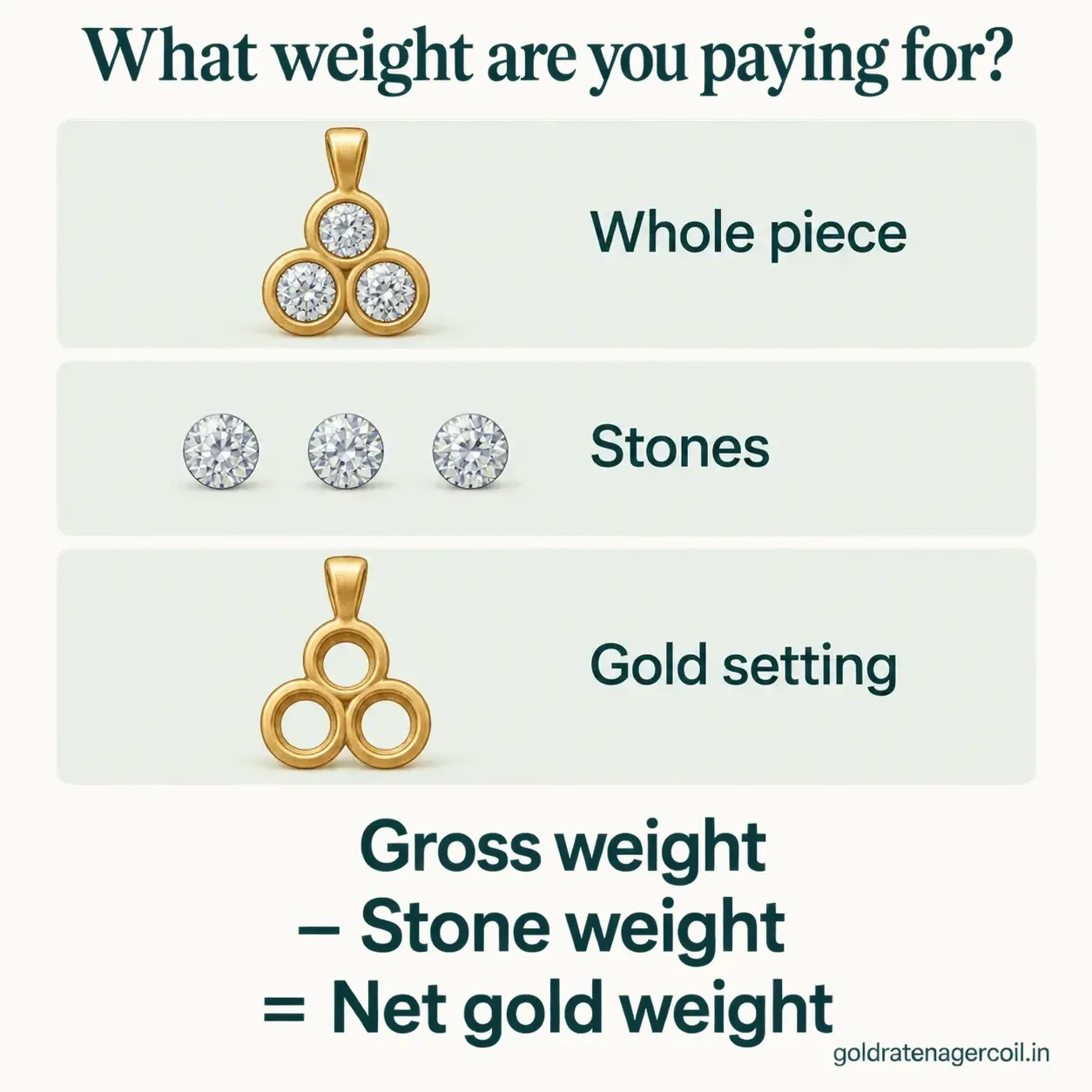
Stones have a price of their own, set by the shop. It is an amount, not their weight multiplied by the gold rate, and it belongs on the estimate as its own line. Ask to see the piece weighed: a registered jeweller keeps a balance accurate to 0.01 g available for customers, alongside a magnifying glass of at least 10x for reading the mark, and the components of the hallmark displayed in the shop.
The same three weights decide what a shop pays you for old gold: a per-gram rate applies to net gold whether the shop is selling to you or buying from you.
How the bill is built
The metal is only the first line. In order: net gold weight × rate = gold value; the making charge, as a percentage of that value or as rupees per gram of gold, with a minimum replacing it when the calculated charge comes out lower; wastage, if the shop quotes it separately rather than inside the making charge; the stones' price; and GST at 3% of the total transaction value of the jewellery, making charge included. The hallmarking charge is billed as its own line, and this site states no tax rate for it.
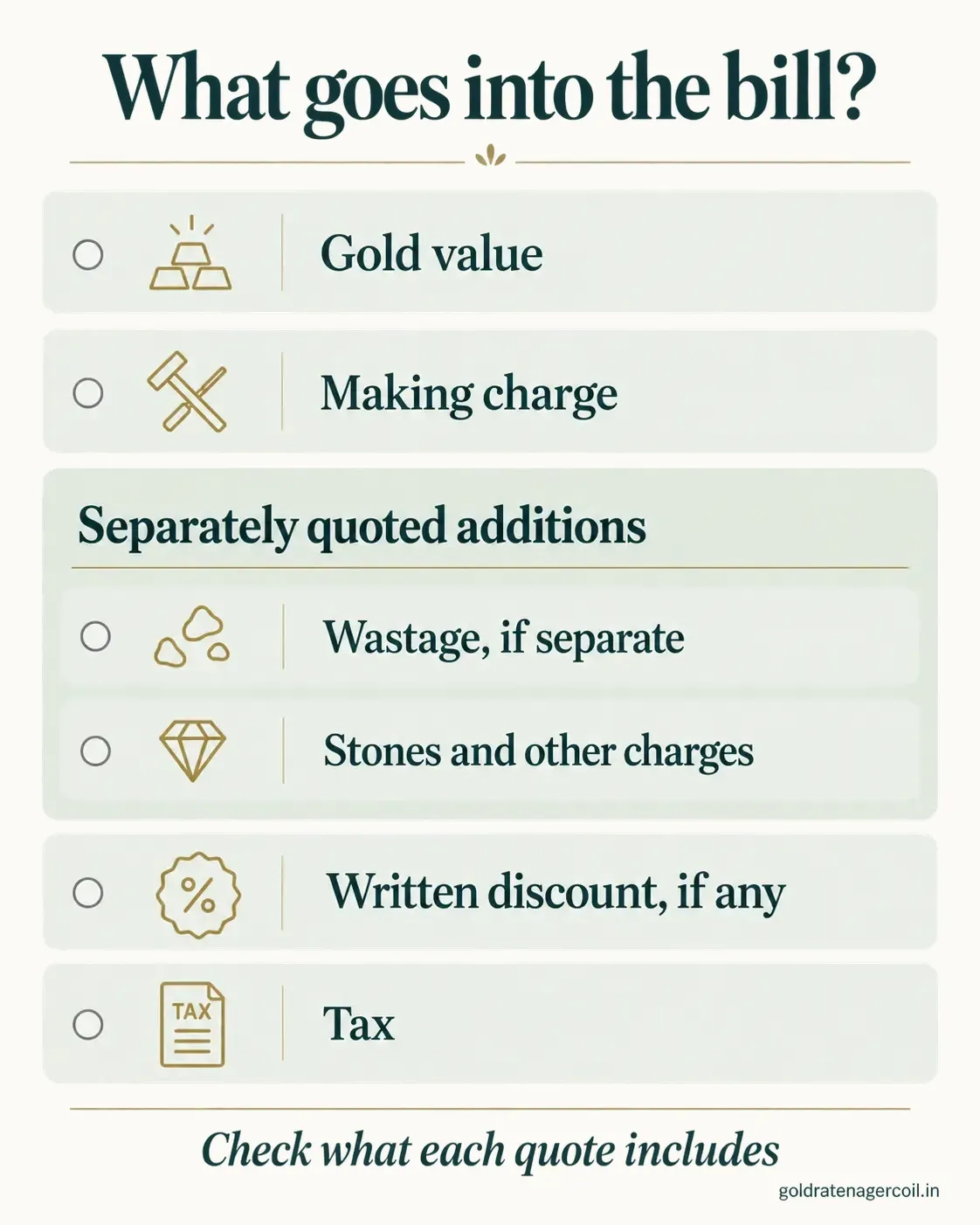
Only two of those lines are the shop's own price. The gold value follows the net weight and the rate, and the tax follows the value, so the making charge and any separately quoted wastage are where two quotes for the same piece actually differ.
GST on gold jewellery is worked on all of those lines together. With a quote in front of you, put it through the calculator and see the same lines with your own figures.
Ask for the shop's terms before you buy
Exchange and buyback terms decide what a piece is worth to you later, and each shop sets its own: the deduction on old gold, whether any of the making charge comes back on an exchange, whether the shop buys back at the day's rate or at a rate of its own, and what proof it asks for. Nothing in the hallmarking rules or the tax on jewellery fixes or caps any of it, so the terms are whatever this shop says they are. Ask for them before the sale, and ask for them in writing.
Selling old jewellery is allowed whether or not it is hallmarked, so an unhallmarked family piece is not unsellable; what it fetches is a matter of testing and the shop's terms. No standard deduction exists, so the only terms that count are the ones your shop states; where a jeweller publishes its own, its profile gives them. Where a Nagercoil jeweller publishes its old-gold terms, the jewellers directory sets them side by side.
Read the bill before you pay
The bill for a hallmarked article must describe each article separately, give the net weight of precious metal, the purity in carat and fineness, and the hallmarking charge, and must state that you can have the purity verified at a BIS recognised assaying and hallmarking centre. Read those lines at the counter, not in the car afterwards.
Check them against what you were told. If the piece is marked 22K916 but the bill says 18K, or the net weight on the bill is the gross weight you were quoted, or the rate per gram is not the one the estimate was worked on, that is the moment to sort it out. A bill that separates the purity, the net weight and each charge is also the only thing you can put through a calculation of your own.