Gold Loan Per Gram
Lenders value a gram of 22K gold at ₹13,810 to ₹13,812 in their latest figures, dated 25 September 2026. On a consumption loan RBI caps what you can borrow at 85% of that value: at most ₹11,739 to ₹11,740 a gram. That 85% holds up to ₹2.5 lakh. The ceiling falls to 80% above that, and above ₹5 lakh it is 75%, ₹10,358 to ₹10,359 a gram. What a lender actually offers is its own share of its own value for your gold's purity and net weight, and it can be lower.
Each lender's own gold loan per gram, and the value it is a share of, is below with its date. The estimate further down is for checking an offer against. It is not a loan offer.
Gold Loan Rate Per Gram Today, by Lender
Lenders publish one of two figures. Most give the value they put on a gram of 22K gold, which is what the loan is a share of. Bank of Baroda and Union Bank of India give the loan itself: the amount on a gram at the share they name.
| Lender | Value of 22K gold, per gram | Gold loan per gram of 22K | Date |
|---|---|---|---|
| Bank of Baroda | Not published | ₹11,057 at 80% ₹10,367 at 75% ₹9,675 at 70% ₹8,985 at 65% |
25 Sep 2026 |
| Canara Bank | ₹13,810 | Not published | 25 Sep 2026 |
| ICICI Bank | ₹13,811 | Not published | 25 Sep 2026 |
| Union Bank of India | ₹13,812 | ₹9,659 at 70% | 25 Sep 2026 |
Bank of Baroda, ICICI Bank, Manappuram Finance, Muthoot FinCorp and Union Bank of India each call their own figure approximate or indicative, with the branch's valuation deciding the loan.
How the Gold Loan Rate Per Gram Is Calculated
Two figures make it: the value the lender puts on your gold, and the share of that value it lends. RBI limits both, for banks and NBFCs alike.
The value is the price for your gold's purity, taken as the lower of its average closing price over the preceding 30 days and its closing price on the day before, as published by the India Bullion and Jewellers Association (IBJA) or a commodity exchange regulated by SEBI (RBI's directions on lending against gold, paragraph 41). Taking the lower of the two keeps a sudden rise from lifting the value straight away. ICICI Bank, Indian Bank and Federal Bank say on their own pages that they use IBJA's figures, and every lender has to show on its website the price it values gold at.
What Is the Maximum Gold Loan Per Gram?
85% of the lender's value for a gram, on a consumption loan up to ₹2.5 lakh: ₹11,739 a gram at ₹13,810, the lowest lender value above. That is the most a loan of that size can be, not an amount any lender has offered. The share is the loan-to-value ratio. For a consumption loan, which is any gold loan not taken for a productive purpose such as farming or a business, RBI sets a ceiling by the size of your total consumption gold loan:
| Total consumption gold loan | Most it can be | Per gram of 22K |
|---|---|---|
| Up to ₹2.5 lakh | 85% of the value | ₹11,739 |
| Above ₹2.5 lakh, up to ₹5 lakh | 80% of the value | ₹11,048 |
| Above ₹5 lakh | 75% of the value | ₹10,358 |
These are ceilings, and a lender may lend less: Bank of Baroda, for one, lends at most 75% on a consumption loan below ₹2.25 lakh, 70% up to ₹5 lakh and 65% above. On a bullet loan, where interest is paid with the principal at the end, the interest due at maturity counts inside the share, so the cash you receive is less than the ceiling. A bullet consumption loan runs for 12 months at most and can then be renewed. The share has to hold for the whole loan, and the lender's own policy says what happens if a fall in the gold price takes it over.
Why Is a Lender's Value Below the Nagercoil Gold Rate?
A lender uses neither the Nagercoil gold rate nor a shop's board rate. It works from the IBJA or exchange price RBI names. The latest Nagercoil gold rate, ₹14,010 a gram of 22K on 25 September 2026, is the rate for the metal, before making charges and GST, and a shop's board rate may differ from it. Lenders' values dated the same day were ₹13,810 to ₹13,812, ₹198 to ₹200 lower. The gold value calculator works a piece's metal value at that Nagercoil rate.
Gold Loan Calculator: Estimate the Loan Amount on Your Gold
Enter the net weight and purity of what you would pledge, the value your lender puts on a gram of 22K, and the share it lends. For a consumption loan the estimate never goes above RBI's ceiling for a loan of that size.
Estimated Loan
Worked from Canara Bank's value for 22K (25 Sep 2026) and an example share of 75%.
- Net gold weight
Stones, lac, strings and fittings are not valued - 8 g
- Value per gram of your gold
₹13,810 per gram of 22K, as entered - ₹13,810
- Value of your gold
8 g × ₹13,810 per gram - ₹1,10,480
- At the lender's share of 75%
75% of the value of your gold - ₹82,860
- Estimated loan
₹10,358 per gram of your gold, before interest and charges - ₹82,860
An estimate from the figures entered, not a loan offer. The lender's assay, its own share and any interest due at maturity decide the amount. Nothing typed here is stored or sent anywhere.
Gold Loan Amount on 1 Pavan (8 Grams) of 22K Gold
A pavan, or sovereign, is 8 grams. At ₹13,810 a gram, the lowest of the lenders' values above, one pavan of 22K gold is worth ₹1,10,480 to a lender. At RBI's ceiling for a consumption loan up to ₹2.5 lakh, 85%, the most it can raise is ₹93,908. At 75% it is ₹82,860. Both are worked on the lender's value. The Nagercoil gold rate puts the same pavan at ₹1,12,080 before any charges.
How Much Gold Is Needed for a ₹1 Lakh to ₹10 Lakh Loan?
At ₹13,810 a gram, a ₹1,00,000 consumption loan needs at least 8.6 g of 22K gold, and a ₹10,00,000 loan needs 96.6 g, about 12.1 pavan.
| Loan | RBI ceiling | Least 22K gold |
|---|---|---|
| ₹1,00,000 | 85% | 8.6 g, about 1.1 pavan |
| ₹2,50,000 | 85% | 21.3 g, about 2.7 pavan |
| ₹5,00,000 | 80% | 45.3 g, about 5.7 pavan |
| ₹10,00,000 | 75% | 96.6 g, about 12.1 pavan |
Interest accrues on whatever you take. On a bullet loan the interest due at maturity comes out of the same share, and the share has to hold for the whole loan, so the more a piece is borrowed against, the less room there is if the gold price falls.
Purity and Net Weight: 22K, 18K and Gold Coins
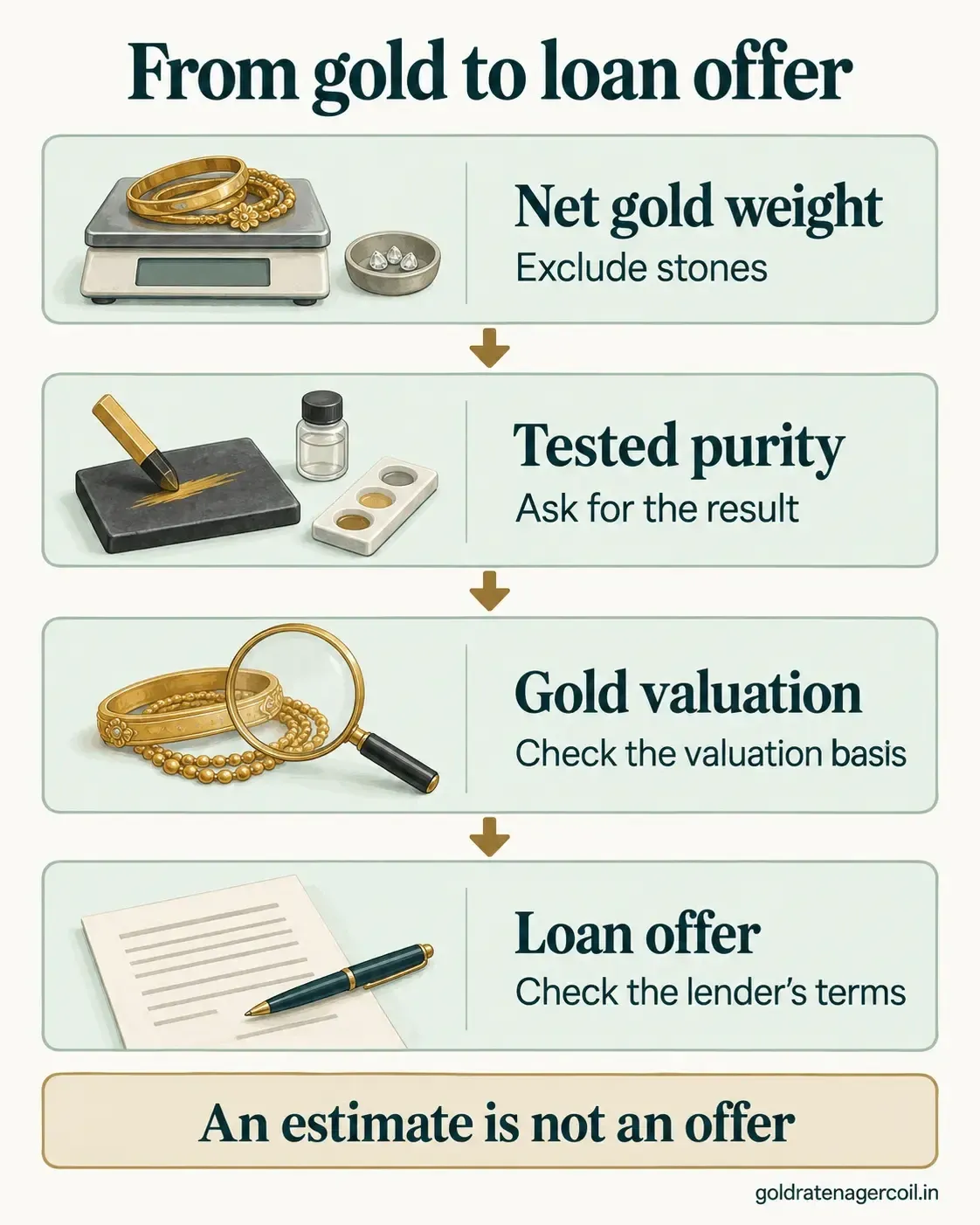
Only the gold is valued. Stones, gems and other costs add nothing, and the weight of stones, lac, alloy, strings and fastenings comes off to give the net weight. The piece is tested in front of you, and the lender gives you a certificate with its purity in carats, its gross and net weight, each deduction, any damage, a photograph and the value it was given. The net weight and the purity on that certificate are the two figures your loan is worked on, so check them.
Purity counts in proportion to the gold. Where no price is published for your gold's purity, the lender takes the nearest one and adjusts the weight, so 18K gold, 750 parts per thousand (916 and other hallmark grades), is worth 750 ÷ 916 of the 22K value: ₹13,810 for 22K is ₹11,307 a gram for 18K. A lender that uses a published 18K price may differ slightly. A hallmark states the purity the piece was assayed at: check the hallmark before you pledge it.
Jewellery, ornaments and coins can be pledged. Bars and other primary gold cannot, and neither can gold ETF or mutual fund units. Gold coins are limited to 50 grams per borrower across all loans.
SBI, Indian Bank, Federal Bank, Muthoot Finance: Gold Loan Per Gram
These four lenders publish the share of the value they lend rather than a rupee figure, so their gold loan per gram is their own valuation times the share below.
| Lender | Share of the value it lends | What it values gold at |
|---|---|---|
| Federal Bank | Up to 75% on a consumption loan, up to 85% on an income-generating loan | IBJA's 22K price, the lower of its 30-day average and the previous day's close |
| Indian Bank | Up to ₹2.5 lakh: 80% on EMI or overdraft; 77%, 80% or 82% on a 12-, 6- or 3-month bullet loan. Up to ₹5 lakh: 75%; 72% to 77%. Above: 70%; 67% to 72% | IBJA's price for the purity, the lower of its 30-day average and the previous day's close |
| Muthoot Finance | 85% on loans of ₹5,000 to ₹2.5 lakh, 80% up to ₹5 lakh, 75% from ₹5 lakh, by scheme | Not published |
| SBI | 72% on an EMI loan, 65% on a 12-month bullet loan, 74% on an overdraft, whatever the loan amount | A market price the bank sets daily and does not publish |
How Much Gold Loan Does SBI Give on 10 Grams?
On an EMI loan, 72% of SBI's own value for 10 grams of 22K gold, and on a 12-month bullet loan 65%. SBI publishes these as margins, 28% and 35%, the part of the value it keeps back. It does not publish the price, so the rupee amount comes only from a branch. Muthoot Finance's own gold-loan-per-gram page prints no figure either.
Why an Estimate Is Not a Loan Offer
- The share is the lender's. RBI's percentages are ceilings. Bank of Baroda lends at 75%, 70% or 65% by the size of a consumption loan, and Union Bank's calculator uses 70%.
- Interest can come out of it. On a bullet loan, the interest due at maturity counts inside the share.
- The purity and the weight are the lender's. Its test decides both, and both go on your certificate.
- The value moves every day. It is the lower of two published prices on the day of the loan, and the figures above carry their own dates.
- Charges are separate. Every charge you pay, assaying included, has to be in the loan agreement and the key facts statement you are given.
- The share has to hold for the whole loan. If the gold price falls far enough, the lender's policy on a breach applies.
Pledging Gold for a Loan or Selling It
A gold loan is borrowing against a piece you keep title to: it is pledged, and it comes back when the loan is repaid. A sale or an exchange ends your ownership, and what it pays is the buyer's rate for the purity your piece tests at, less whatever its terms deduct (estimating an exchange value).
A consumption loan gives you at most 85% of a value set from a published benchmark, and the gold comes back. A sale pays the buyer's whole figure, and the gold is gone. Which suits you depends on whether you want the piece back.
Getting Your Gold Back and What Happens at an Auction
Once the loan is repaid in full the gold comes back the same day, and within seven working days at most. For a delay that is the lender's fault it pays you ₹5,000 for every day beyond that (RBI's conduct directions for banks; the NBFC directions say the same).
If the loan is not repaid, the lender has to give you notice before it auctions the gold. The reserve price is at least 90% of the gold's current value, or 85% after two failed auctions, and anything left after the loan is settled is refunded within seven working days of the proceeds. The notice period is the lender's own and is in the loan agreement. The terms have to be given in the language of the region, or one you choose.
Questions to Ask a Gold Loan Lender Before You Pledge
- "What value per gram of 22K are you using, and from which date?" A lender has to publish the price it values gold at, so the answer can be checked.
- "What share do you lend on this loan, and is it a consumption loan?" RBI's ceiling depends on both, and a lender's own share can be lower.
- "How much of the share goes to interest due at maturity?" On a bullet loan it counts inside the share, so the cash in hand is less.
- "What purity and net weight did the test give?" Both are on the certificate, and together with the value they set the loan.
- "Which charges come out of the amount?" Each has to be in the loan agreement and the key facts statement.
- "What happens if the gold price falls during the loan?" The share has to hold throughout, and the lender's policy says what it does when it does not.