Gold Making Charges and Wastage
Gold making charges are what a shop asks for the workmanship on a piece, quoted either as a percentage of the gold value or as rupees per gram of net gold. The two bases give different answers on the same piece, so a quote means little until you convert one into the other. Wastage may sit inside that charge or be quoted on top, stones are priced apart from their weight, and GST applies to the value of the jewellery, making charge included.
A rate tells you about the metal. The rest of the bill is where two quotes on the same piece differ.
What is actually on a gold jewellery bill
A bill for a finished piece is built in this order, which is the order the calculator follows. Each line answers a different question, and a shop can be cheap on one and dear on another.
- Net gold weight.The weight of gold you are actually buying: the item's gross weight less any stones or other non-gold parts.
- Gold value.Net gold weight multiplied by the rate per gram for that purity. Nothing else belongs in this line.
- Making charge.The workmanship, quoted as a percentage of the gold value or as rupees per gram of net gold. A minimum, where one applies, is a floor on this line.
- Wastage or value addition.Counts only when the shop quotes it as a separate line. It may instead be inside the making charge you were quoted, so ask which.
- Stones and other components.A price the shop sets for the stones. It is not calculated from their weight.
- Other fixed charges.Small per-article amounts such as the hallmarking charge.
- GST.3% of the transaction value of the jewellery, making charge included, for a finished piece bought from a jeweller.
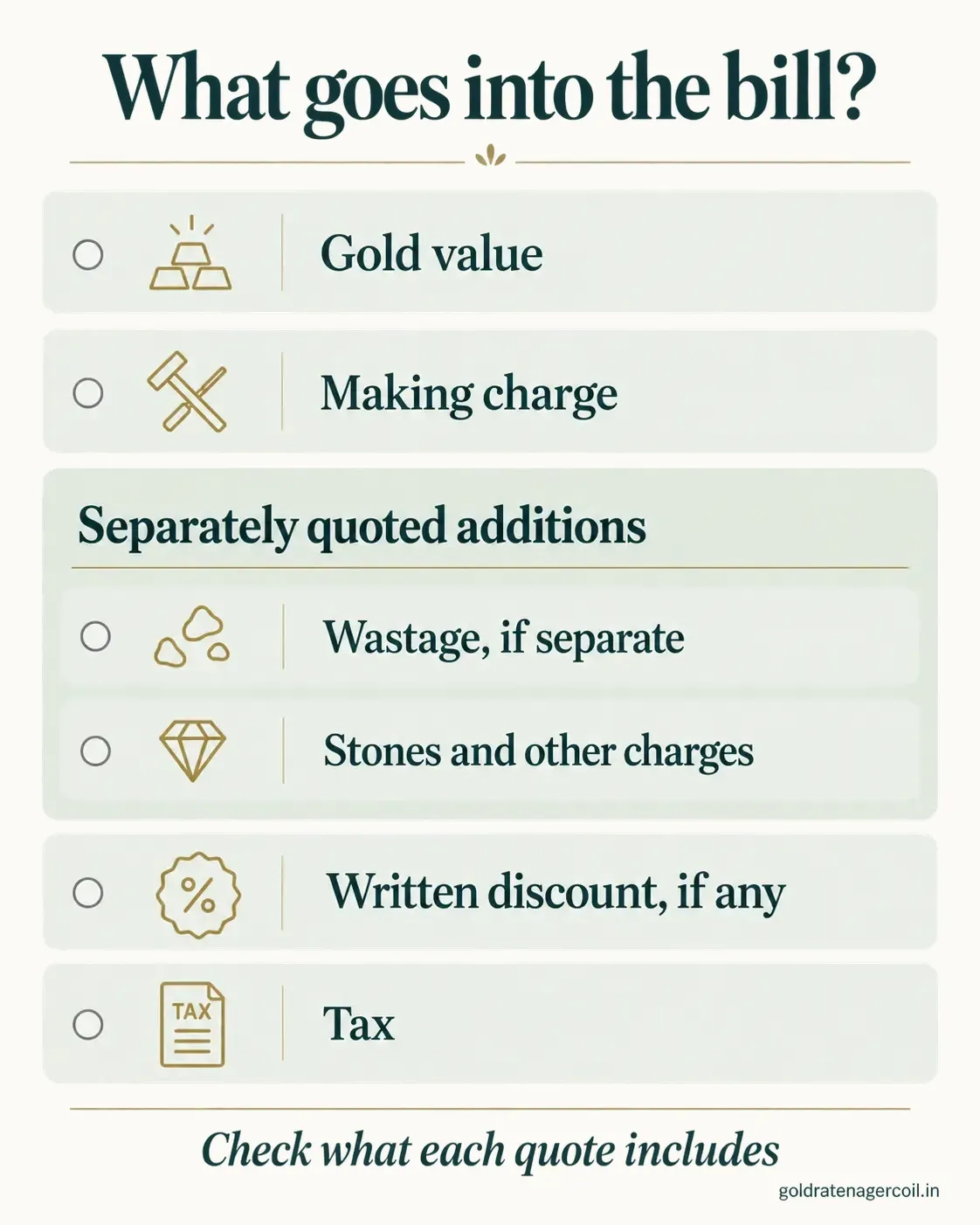
The bill for a hallmarked article must show each article separately, its net precious-metal weight, the purity in carat and fineness, and the hallmarking charge, and must tell you that you can have the purity verified at a BIS recognised assaying and hallmarking centre. If a quote will not separate those things, you cannot compare it with another.
The rules fix what the bill must disclose and the tax on it. The making charge itself is the shop's price for the design, not a published rate, so two shops can charge very differently for the same weight of gold.
Only the first two lines are metal. That is what decides the value of the piece if it later goes back across the counter: an exchange or a resale starts from the gold, and the making charge, the wastage and the tax are not in it (how an exchange value is worked out).
Making charges: percentage or per gram
Both bases are ordinary. What matters is that they answer differently on the same piece, so a "12%" quote and a "₹1,200 per gram" quote cannot be compared until you do the arithmetic. The examples below use a round ₹14,000 per gram so they stay valid as the rate moves. The latest 22K gold rate in Nagercoil is ₹14,010 per gram, ₹1,12,080 per pavan (8 grams), as on 25 September, 9:36 am.
Your jeweller's board rate may differ from it. Making charges, any separately quoted wastage and GST come on top.
Example 1: one pavan, quoted two ways
8 g of net 22K gold at ₹14,000 per gram. The percentages are illustrations, not Nagercoil shop rates.
| Line | At 12% of gold value | At ₹1,200 per gram |
|---|---|---|
| Gold value | ₹1,12,000 | ₹1,12,000 |
| Making charge | ₹13,440 | ₹9,600 |
| GST at 3% | ₹3,763 | ₹3,648 |
| Total | ₹1,29,203 | ₹1,25,248 |
A difference of ₹3,955 on one pavan, from the quote basis alone. The two bases also behave differently as the rate moves: a percentage charge rises with the gold rate, while a per-gram charge does not change until the shop changes it. Work out both figures for the piece you are buying rather than assuming either basis is the cheaper one.
Convert a per-gram quote into a percentage, and back
Both conversions need only the rate per gram the shop is using, so ask for it before anything else.
- Per gram to a percentage: divide the per-gram charge by the rate per gram, then multiply by 100. At ₹14,000 per gram, ₹1,200 per gram is 8.57% of the gold value.
- Percentage to per gram: multiply the rate per gram by the percentage. At the same rate, 12% is ₹1,680 per gram of net gold.
So the 12% quote in the example above is the dearer of the two: at ₹14,000 per gram it works out to ₹1,680 per gram, against ₹1,200. The comparison holds at that rate only. Both charges apply to net gold weight, so a per-gram figure is never multiplied by the gross weight of a stone-set piece. Work the conversion out at the rate on the quote in front of you, or enter both quotes in the bill calculator.
Making charges on a 22K piece
Purity changes the making charge only through the gold value it is calculated on. A percentage charge on a 22K piece applies to the 22K gold value, so the same percentage on a lower-purity piece of the same weight produces a smaller rupee charge: the difference comes from the rate, not from the workmanship. A per-gram charge is a figure per gram of net gold and does not move with purity unless the shop changes it.
So "22K making charges" are not a separate kind of charge, and a 916 quote is a 22K quote (what 916 and KDM mean). Ask which basis the shop is using, on what net weight, and at which rate per gram; those three answers settle the charge on any purity.
How minimum making charges work
A minimum making charge replaces, it does not add. Where a shop sets a floor it applies to the making charge alone: if the calculated charge is below the floor, the floor becomes the charge. It is not added on top of it, and it does not absorb wastage, stones or any fixed fee.
Example 2: a 2 g piece with a ₹3,500 minimum
- Gold value
2 g × ₹14,000 per gram - ₹28,000
- Making charge, calculated at 10%
below the shop's minimum - ₹2,800
- Making charge, applied
the minimum replaces the calculated charge - ₹3,500
- GST at 3%
- ₹945
- Total
- ₹32,445
The floor is charging 12.5% of the gold value on this piece, not the 10% quoted. ₹3,500 is the figure to compare with another shop's, and getting the percentage down will not move this bill while the same floor applies.
If the minimum were added to the calculated charge instead of replacing it, the making line would read ₹6,300 and the bill would be ₹35,329 — about ₹2,884 more. If a quote looks like that, ask which it is.
A floor bites hardest on light pieces, because the calculated charge falls with the gold value while the minimum does not. On a small ring it can be most of what you pay above the metal. Whether it applies at all to a heavier piece is arithmetic you can do: multiply the percentage by the gold value, and compare the answer with the floor the shop quoted.
Wastage, and the double-counting trap
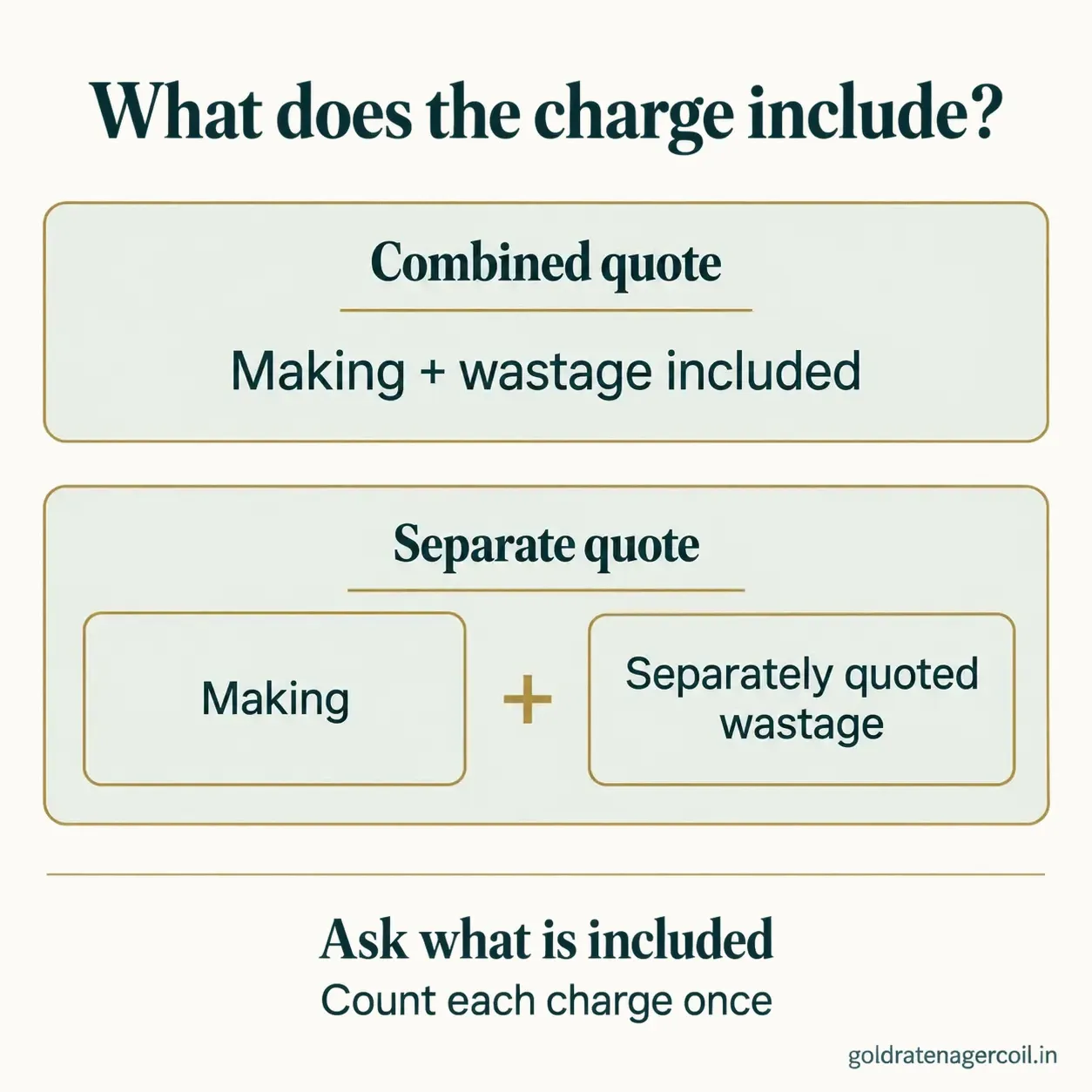
Wastage is quoted as a percentage of the gold value, and is charged on the premise that metal is lost in working the piece. Whatever the estimate calls it, the question that changes your bill is whether it is already inside the making charge you were quoted.
A quote of "12% making, wastage included" and a quote of "12% making plus 5% wastage" are not the same offer, so add the two percentages together before comparing, and enter wastage only where the shop names it as a separate line. A separately quoted line has arithmetic of its own: what wastage is charged on, and what it adds to a one-pavan bill.
Stone weight and stone price are different things
Stones are not gold and must not be priced at the gold rate. Their weight is deducted from the item's gross weight to find the net gold weight; their price is a separate amount the shop sets. Deduct the weight once, and never let a stone weight be turned into a stone price by multiplying it by the gold rate.
Fixed charges, including hallmarking
BIS sets the hallmarking charge at ₹75 per article for gold and ₹35 per article for silver, with applicable taxes extra. It is per article rather than per gram, and the bill for a hallmarked piece has to show it as its own line. Other genuine fixed fees belong in the same place, separate from the minimum making charge, which is a floor rather than a fee.
How a shop's separately billed hallmarking fee is taxed is a different question from the tax on the jewellery, and this page states no rate for it. Ask for it as its own line on the estimate, with whatever tax the shop applies to it shown beside it, so it never disappears into the making charge.
GST on gold making charges
For a finished piece bought from a jeweller, GST is 3% of the transaction value of the jewellery, making charge included, whether or not the invoice shows the making charge separately. So a making charge is not a labour line taxed at a rate of its own: it goes into the figure the 3% is worked on, and a rupee off it is a rupee off that figure. The 5% job-work rate concerns work on another registered person's goods, not a finished piece you buy, so the GST on a jewellery bill is the 3%.
Example 3: gross weight, stones and separately quoted wastage
An 8.4 g item with 0.4 g of stones, so 8 g of net gold at ₹14,000 per gram; 12% making, 5% wastage quoted separately and ₹2,500 of stones. Any hallmarking fee is left out, for the reason given above.
- Net gold weight
8.4 g gross less 0.4 g of stones - 8 g
- Gold value
8 g × ₹14,000 per gram - ₹1,12,000
- Making charge
12% of the gold value - ₹13,440
- Wastage or value addition
5% of the gold value, quoted separately - ₹5,600
- Stones or pearls
Priced by the shop, not by weight - ₹2,500
- Subtotal before GST
- ₹1,33,540
- GST at 3%
On the subtotal above, making charge included - ₹4,006
- Estimated bill
- ₹1,37,546
Without the separately quoted wastage and the stones, the same piece comes to ₹1,29,203. The extras add ₹8,343 to the bill, which is why they are worth asking about one by one. Put your own quote through the gold price calculator at the current rate.
How to compare two making-charge quotes
Two quotes are comparable only when they price the same thing. Before comparing, fix four points for both: the net gold weight, the purity on the hallmark, the rate per gram each shop used, and whether wastage is inside the making charge or on top. Then put both through the same arithmetic.
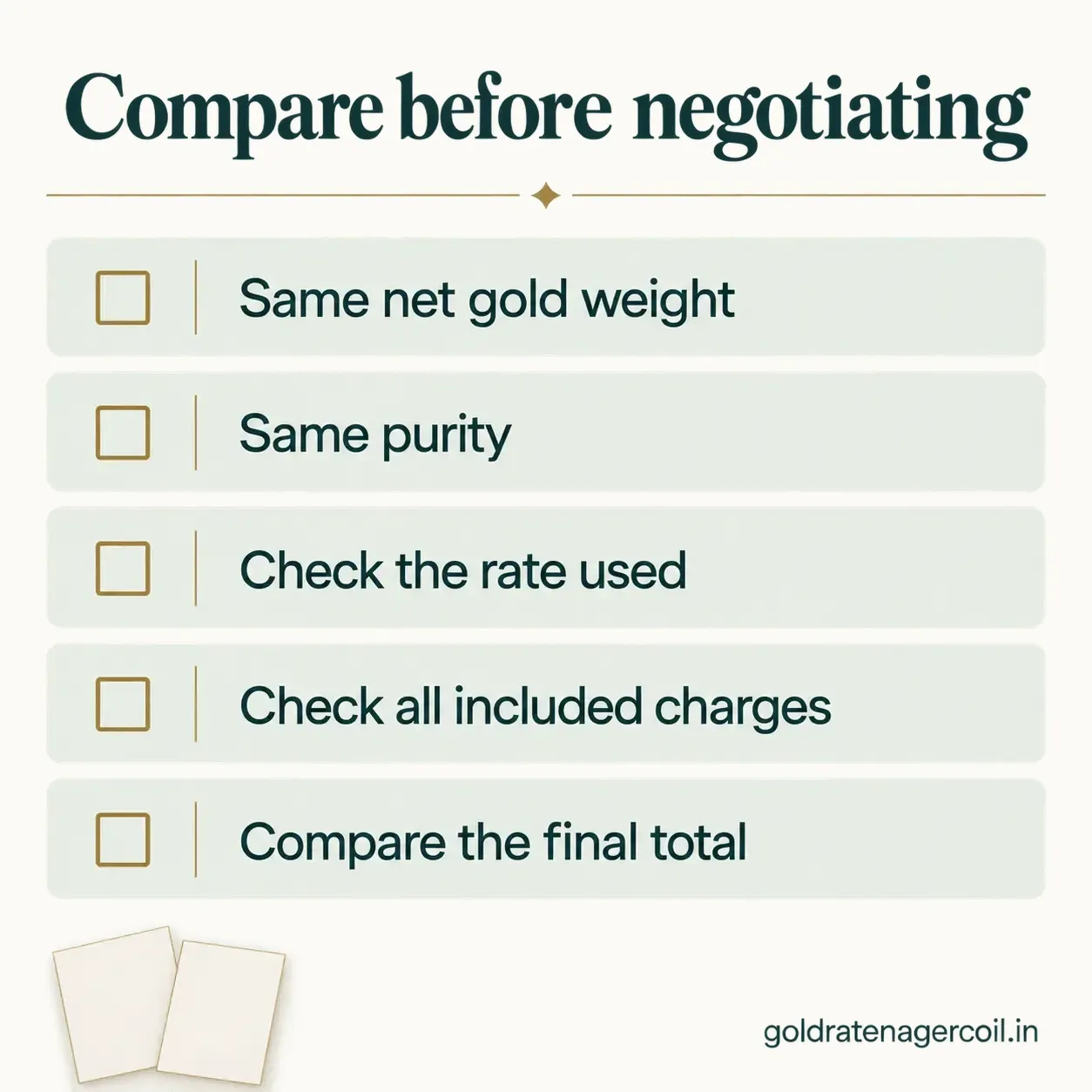
- Same weight and purity.Net gold weight from the shop's balance, and the fineness on the mark. A heavier or purer piece is a different item, not a dearer quote.
- Same rate.Where the two shops used different board rates, work both bills out at one rate to see the charges on their own; the jewellery bill calculator accepts any rate you type.
- Same basis.Turn a per-gram quote into a percentage of the gold value for that piece, or the other way round, so the two charges sit side by side.
- Same extras.Add wastage only where it is quoted separately, then the stone price and any fixed charge, then GST on the whole.
Those four steps answer one question: which shop asks more above the metal. Holding both quotes at a single rate isolates the charges, and the answer is no longer what either shop would bill you. What you would actually pay is a second sum, each quote at the rate that shop is using with every charge it applies. The two can disagree, and the shop with the lower making charge can still hand you the larger bill.
So a lower percentage does not guarantee a lower bill. The percentages on this page are illustrations, not a Nagercoil shop's charges. For one Nagercoil jeweller's own figures, see what Harris Nadar Jewellery charges as Value Added, piece by piece. Once both quotes are on one basis, what each concession is worth when you negotiate making charges decides which line to ask about.
Reading a Nagercoil quote that shows only a total
When a quote arrives as one figure for the finished piece, you can still separate the metal from the charges. It takes two numbers, and both come from the shop: the net gold weight and the rate per gram it used. Do not put the rate above in place of the shop's own, because a different board rate would turn up in your answer as workmanship.
- Take the tax out first.Ask whether the figure includes GST. If it does, divide it by 1.03: the tax is 3% of the pre-tax value, so the quoted figure is 1.03 times the value you are after.
- Subtract the gold value.Net gold weight × the shop's own rate per gram. What is left is everything charged above the metal before tax: making, any wastage, the stones and any fixed fee.
- Turn that into a percentage.Divide it by the gold value and multiply by 100. That figure is the whole non-metal cost rather than a making-charge percentage, so it compares only with another shop's figure worked out the same way, on a piece of the same weight and purity with the same things included.
The Nagercoil rate is a sanity check rather than an input. One pavan of 22K gold is ₹1,12,080 at the figure above, so a one-pavan quote close to that leaves little room for charges, and one well above it is worth breaking down line by line. A shop's board rate may sit either side of it, which is why the arithmetic uses the rate the shop gives you. Then ask it to split the remainder into lines, and compare the lines rather than the totals.
Questions to ask before you pay
- "Is the making charge a percentage or per gram, and what is the figure?" Then work out the other basis for the same piece before comparing shops.
- "Is wastage included in that, or charged separately?" Two quotes cannot be compared until you know this for both.
- "Is there a minimum making charge on this piece?" A floor only changes the bill when the calculated charge falls below it, which is a question of how little gold the piece holds.
- "Is this weight gross or net, and what do the stones weigh?" Ask to see the piece weighed; shops keep a balance accurate to 0.01 g for customers.
- "What is the price of the stones?" It should be a stated amount, not a weight multiplied by the gold rate.
- "Does this figure include GST?" A quote given before tax will always look cheaper than the same piece quoted after it.
- "Will the bill show the purity, the net weight and the hallmarking charge separately?" For a hallmarked article it has to, and ask for the tax as its own line too. The bill is what you will need if anything is disputed later.