How to Calculate Gold Price for 22 Carat Jewellery
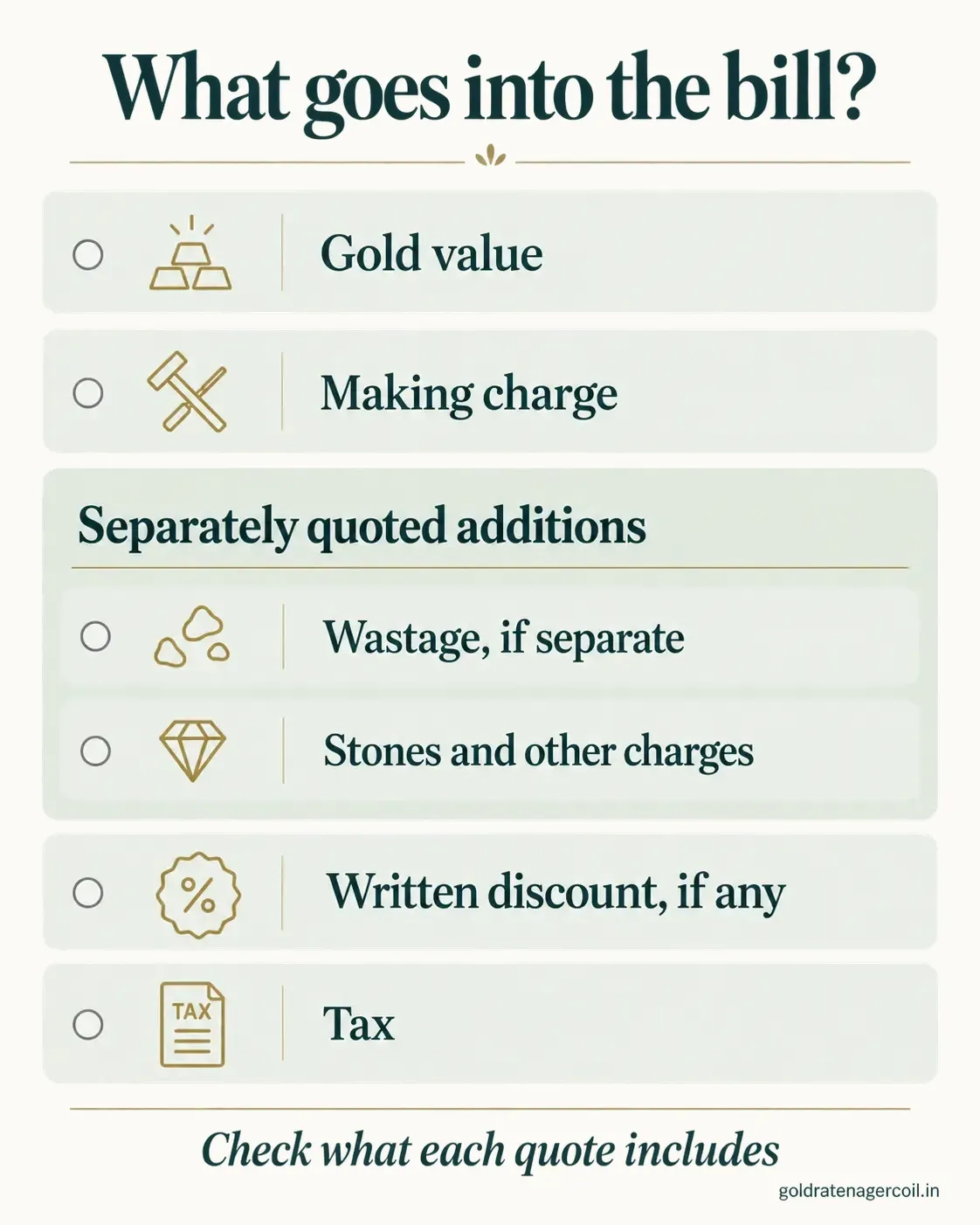
The price of a gold jewellery piece is its gold value (net weight × rate per gram) with the making charge, any wastage, stones and other charges added, and 3% GST on that total. The 22K rate is quoted per gram, so it needs no working out. The price of a piece does, and a shop builds its bill in this order:
- Net gold weight. The gross weight less any stones and other non-gold parts. Only the net gold is priced at the rate.
- Gold value. Net weight × the 22K rate per gram. At ₹14,010, one pavan (8 grams) of 22K gold is worth ₹1,12,080.
- Making charge. A percentage of the gold value, or rupees per gram of net gold. Where the shop has a minimum making charge and the calculated charge is lower, the minimum is the charge.
- Wastage, stones and other charges. Wastage when the shop quotes it on top of the making charge, and the price the shop puts on the stones.
- GST. 3% of the value of the jewellery, making charge included.
The calculator opens on one pavan at an example making charge of 10% and nothing else, which comes to ₹1,26,987. To check a shop's quote, type the shop's own rate per gram into the rate field; it can differ from the rate above.
Worked Example: A 1 Pavan Bangle With Stones
The charges here are examples to show the arithmetic, not a Nagercoil shop's charges. A bangle weighs 8.4 g on the scale with 0.4 g of stones, so the net gold is 8 g, one pavan. At ₹14,010 per gram the gold value is ₹1,12,080. A 12% making charge adds ₹13,450. With no wastage quoted and no stone price, the subtotal is ₹1,25,530. GST at 3% adds ₹3,766, for an estimated bill of ₹1,29,295.
Quote the making charge as ₹1,200 per gram instead and the making line becomes ₹9,600 (8 g × ₹1,200), for a bill of ₹1,25,330. The same piece gives a different bill on each basis, so ask which one a quote uses.
Now give the shop a minimum making charge of ₹15,000 and 4% wastage quoted separately. The calculated 12% charge, ₹13,450, is below the minimum, so the making line becomes ₹15,000. Wastage of ₹4,483 goes on top, the same money as 0.32 g added to the weight. That makes a subtotal of ₹1,31,563 and, with GST, a bill of ₹1,35,510. The minimum sets that making line, so asking for a lower percentage would not move this bill (how a minimum making charge works).
How Much Does 1 Gram of 22K Gold Jewellery Cost?
At an example making charge of 10%, a gram of plain 22K jewellery comes to ₹15,873 with GST, and each percentage point of making charge adds ₹144 a gram. The gold in it is worth the 22K rate, ₹14,010 on 25 September; the making charge and GST make up the rest. Wastage, stones and a minimum making charge raise it further. When you sell a piece back, a shop pays its own buying rate for the purity the piece tests at, less whatever its terms deduct (estimating an exchange value).
Gold Rate Calculator for 22K, 18K and 24K
Choose the purity the piece is made in, and the calculator uses that purity's own rate per gram.
- 22K, marked 916 (91.6% gold): the Nagercoil 22K rate, ₹14,010 per gram, as on 25 September, 9:36 am.
- 18K, marked 750 (75% gold): the Nagercoil 18K rate, ₹11,780 per gram, as on 25 September, 9:36 am.
- 24K, 999 fine gold: the national benchmark, ₹15,211 per gram at the closing rate of 25 September. It is not a Nagercoil quote, and coins carry a premium over it. Hallmarked 24K jewellery is 995 fine, marked 24KS995, ₹15,150 per gram on the same benchmark.
These rates are for the metal alone. A shop's board rate may differ, and making charges, any separately quoted wastage and GST come on top.
How Is the Price of 916 Hallmark Gold Calculated?
At the 22K rate per gram. 916 is the hallmark for 22K gold, 91.6% pure, so a 916 piece takes the 22K rate, with its charges and GST added as for any other piece. The 22K rate is a figure of its own. It is not 91.6% of any 24K figure, and the calculator never works one purity out from another. Equal weights are not equal gold, so a 22K and a 24K price per gram cannot be compared directly (which purity suits a purchase: 22K or 24K gold). 18K is marked 750 the same way (what 916 and 750 mean).
Making Charges and Wastage Calculator: Enter a Shop's Quote
Enter the making charge the way the shop quotes it, as a percentage of the gold value or as rupees per gram of net gold (converting making charges per gram into a percentage). If the shop names a minimum making charge, enter that too. The calculator uses whichever is higher, the calculated charge or the minimum, and adds wastage after it.
Wastage goes in its own field only when it is quoted on top of the making charge. Pick the form the quote uses: a percentage of the gold value, rupees per gram of net gold, or grams added to the weight. At one rate the three come to the same money, and the bill line shows the wastage as a share of the gold value whichever form you enter (wastage in three forms, worked on one pavan). Added grams are a charge written as weight, and the piece you take home weighs the same. VA is reported both for the wastage alone and for the making charge and wastage together, so ask what a VA figure covers before you decide which field it goes in.
To compare two shops, put each quote through the calculator at that shop's own rate and compare the totals. A lower making-charge percentage does not guarantee a lower bill if the rates or the charges included differ (comparing two quotes). The jewellers directory compares the making charges Nagercoil jewellers list on their own 22K pieces.
What the Gold Price Calculator Assumes
- Rate. The Nagercoil rate per gram for 22K and 18K. Only purities with a rate can be selected. The 24K option is the national benchmark for 999 fine gold, shown with its own date. It is not a Nagercoil quote. In bill mode you can overwrite the rate with a shop's board rate.
- Net gold weight. Either entered directly, or gross item weight minus the stone or non-gold weight. The deduction happens once. Stones are then priced by the amount you enter, not by their weight.
- Making charge. Either a percentage of the gold value or rupees per gram of net gold. A minimum making charge is a floor on that line alone: applied = max(calculated, minimum). It is applied before wastage, stones and other charges are added, and it is not an extra fee.
- Wastage or value addition. Added as a separate line only when you enter it, as a percentage of the gold value, rupees per gram of net gold or grams added to the weight and priced at the rate. It cannot exceed the value of the gold itself. Leave it at 0 when the shop's making charge already includes it (wastage inside or on top).
- Other fixed charges. A separate rupee amount, kept apart from the minimum making charge. Whatever you enter here is taxed with the rest of the bill, so leave out a hallmarking fee or any other service the shop bills and taxes separately (fixed charges on a bill).
- Precision. Weights are used to the thousandth of a gram and every intermediate figure is kept unrounded. Each line is rounded to the nearest rupee only for display, and the total is computed before rounding, so the displayed lines can differ from the displayed total by a rupee.
- Inputs. Weights up to 10,000 g, percentages 0 to 100, no negative amounts, and stones lighter than the item. Anything else shows an error instead of a figure. Nothing you type is stored or sent anywhere; the address bar does not change.
- Defaults. Net weight 8 g (1 pavan), 22K at the Nagercoil rate, an example making charge of 10% of gold value, no minimum, no wastage, no stones, no other charges. "Reset to defaults" restores exactly these. The homepage quick estimate uses the same defaults and the same arithmetic.
Does the Gold Price Calculator Include GST?
Yes. GST is 3% of the total transaction value of the jewellery, making charge, wastage, stones and other charges included, whether or not the shop's invoice shows the making charge as a separate line. A piece made from gold you supply yourself, a hallmarking fee or other service the shop bills separately, old-gold exchange and any cess are outside this estimate (what GST is charged on, and where the 5% job-work figure belongs). Checked against the government's GST FAQ on gems and jewellery on 19 September 2026.